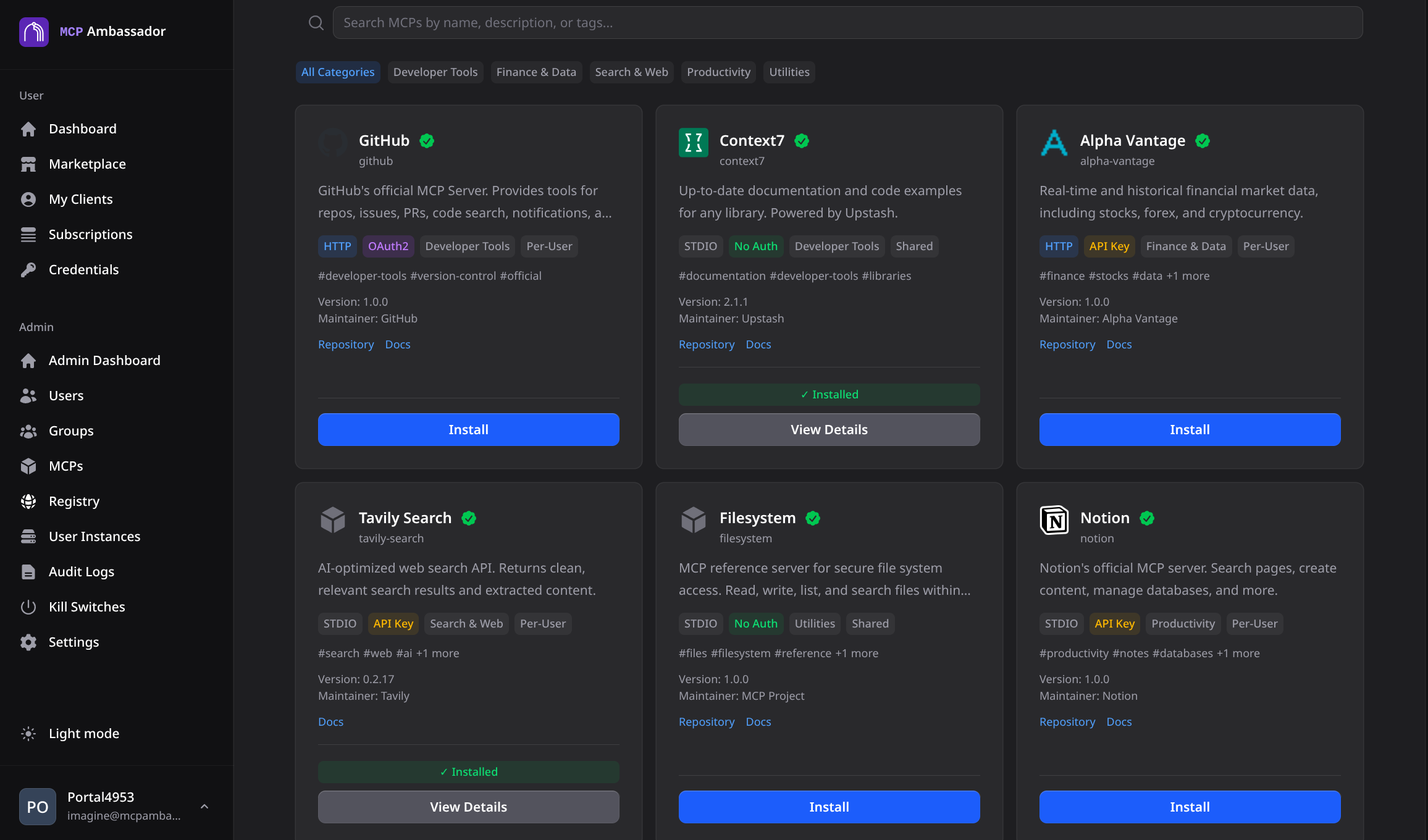
The MCP Ambassador community registry ships spawn commands, environment variable schemas, and tool metadata for 75+ popular MCP servers. Admins add them to the catalog in minutes — no writing spawn commands or figuring out environment variable names from scratch.
Browse 75+ pre-configured MCP servers organized by category. Add any to your catalog with one click.
How to use the registry
Log in to the Admin UI
Navigate to MCP Catalog → Add from Registry
Browse or search the registry
Click Add to Catalog — spawn command and env vars are pre-filled
Optionally edit the configuration (e.g., add your API key)
Click Validate to verify connectivity and fetch tool list
Click Publish and assign to groups
Registry contents
AI & Search
MCP
Description
Credentials
tavily-search
Real-time web search optimized for AI
TAVILY_API_KEY
brave-search
Web and local search via Brave Search API
BRAVE_API_KEY
exa
Neural search engine for AI applications
EXA_API_KEY
Code & Dev Tools
MCP
Description
Credentials
github
GitHub API — search code, manage PRs, issues
GITHUB_PERSONAL_ACCESS_TOKEN
gitlab
GitLab API — projects, MRs, pipelines
GITLAB_PERSONAL_ACCESS_TOKEN
sequential-thinking
Dynamic, reflective problem-solving
None
mermaid
Generate Mermaid diagrams from descriptions
None
Data & Databases
MCP
Description
Credentials
postgres
Query and inspect PostgreSQL databases
DATABASE_URL
sqlite
Read/write SQLite database files
None (file path)
mongodb
Query MongoDB collections
MONGODB_URI
supabase
Supabase database and storage
SUPABASE_URL, SUPABASE_KEY
Documents
MCP
Description
Credentials
markitdown
Convert any document to Markdown
None
google-drive
Read and manage Google Drive files
OAuth credentials
notion
Read and write Notion pages and databases
NOTION_API_KEY
Web Automation
MCP
Description
Credentials
fetch
Fetch and parse web content
None
firecrawl
Crawl and scrape websites
FIRECRAWL_API_KEY
puppeteer
Browser automation with Puppeteer
None (requires Chrome)
playwright
Browser automation with Playwright
None (requires browsers)
Cloud & Infrastructure
MCP
Description
Credentials
cloudflare
Manage Cloudflare zones, DNS, Workers
CLOUDFLARE_API_TOKEN
aws-kb-retrieval
Query AWS Knowledge Base (Bedrock)
AWS credentials
docker
Manage Docker containers and images
Docker socket access
Business
MCP
Description
Credentials
stripe
Stripe payments, customers, subscriptions
STRIPE_API_KEY
monday
Monday.com project management
MONDAY_API_KEY
todoist
Todoist task management
TODOIST_API_TOKEN
zapier
Trigger Zapier automations
ZAPIER_API_KEY
figma
Figma design files and components
FIGMA_ACCESS_TOKEN
slack
Send messages and manage Slack
SLACK_BOT_TOKEN
linear
Linear issue tracking and projects
LINEAR_API_KEY
Monitoring
MCP
Description
Credentials
grafana
Query Grafana dashboards and alerts
GRAFANA_URL, GRAFANA_API_KEY
sentry
Query Sentry errors and events
SENTRY_AUTH_TOKEN
Utility
MCP
Description
Credentials
time
Current time and timezone conversions
None
memory
Persistent key-value memory for agents
None
google-maps
Maps, geocoding, directions
GOOGLE_MAPS_API_KEY
filesystem
Read/write local filesystem
None (path-restricted)
Weekly sync with the official MCP Registry
The community-registry repository runs a GitHub Actions workflow, Sync official registry, that proposes new entries from the official MCP Registry.
Weekly dry run. Every Monday the workflow runs on a schedule. Scheduled runs are always dry runs: they build the candidate set and print what a pull request would contain, and open nothing. The first Monday of each month also walks the whole feed instead of only what changed since the last run.
Pull requests are manual. A maintainer starts the workflow by hand with dry run turned off to open a PR. The sync never merges, never pushes to main, and never installs or runs a candidate package. Every proposed entry is marked verified: false and must be reviewed by a person before it is merged.
Curated intake
Each run proposes a small, ranked set rather than everything in the feed:
Verified publishers first. Candidates whose namespace ownership is provable (io.github.* names, or a remote whose host matches the publisher's reverse-DNS domain) are ranked ahead of the rest.
Per-publisher cap. At most 2 proposed entries per publisher namespace per run by default (configurable 1-50), so no single publisher floods a batch. The overall per-run cap defaults to 10 (1-50).
Repository quality score. For GitHub-hosted candidates, the sync reads the repository's public metadata. Archived repositories, and repositories with no push in the last 12 months, are rejected. The rest are scored as log10(1 + stars), plus 0.5 if the repository is at least 180 days old, and ranked best first within their tier. Candidates without a GitHub repository are unscored and rank after scored ones.
Namespace verification shows who published an entry, not that the package is safe, so reviewers still check the package, its pinned version and the permissions it needs.